We are witnessing a transformative shift in the business landscape as entrepreneurs embrace digital nomadism. Over 10 million Americans identify as digital nomads, with global numbers expected to reach 60 million by 2030. This lifestyle allows for immersion in diverse cultures, drawing inspiration from global experiences. Companies like Tortuga Backpacks, Buffer, and The Nomad have been successfully launched and managed by digital nomads. The United States has become the top destination for this growing demographic, with hotels adapting their services to cater to long-term visitors. Countries like Estonia, Barbados, and Portugal are offering special digital nomad visas to attract remote workers, providing legal residency for extended periods.
Understanding Digital Nomadism and Remote Business Evolution
The concept of digital nomadism has evolved from a niche lifestyle embraced by young adults backpacking across the globe to a diverse group of professionals, including families, seeking a more flexible work environment. A recent Lonely Planet survey reveals that 70% of digital nomads are between 24 and 44 years old, with 35% between 45 and 54. Moreover, nearly half are married, and 70% are parents traveling with their families.
The Rise of Location-Independent Entrepreneurs
The rise of digital entrepreneurship has enabled a growing number of individuals to pursue remote business ideas and establish digital nomad careers. According to the International Labour Organization, there has been a substantial increase in remote work globally, particularly in developed economies with the infrastructure to support digital workplaces. In the United States, a Gallup report from late 2022 found that 45% of full-time employees were working remotely in some capacity, representing a significant increase from pre-pandemic levels.
Key Technologies Enabling Digital Nomad Success
The success of digital nomads is driven by the availability of powerful remote collaboration tools and e-commerce platforms. Tools like Asana, Trello, Slack, and Zoom facilitate seamless remote communication and project management, while platforms such as Shopify and WooCommerce enable digital entrepreneurship and flexible work environment. Freelance marketplaces like Upwork and Fiverr also provide access to a global talent pool, empowering digital nomads to build remote teams and expand their businesses.
Global Statistics and Growth Trends
The digital nomad movement has experienced significant growth in recent years. According to the International Labour Organization, there has been a substantial increase in remote work globally, particularly in developed economies. In the United States, Gallup Inc. reported that remote jobs increased from 24% in 2012 to 31% in 2017, and the latest Gallup report from 2022 found that 45% of full-time employees were working remotely in some capacity. This trend highlights the growing demand for flexible work environment and the evolution of the digital nomad lifestyle.
Online Entrepreneur Lifestyle: From Traditional Work to Digital Freedom
The rise of online entrepreneurs has ushered in a new era of digital freedom. Individuals are transitioning from the constraints of traditional work to the boundless opportunities of online entrepreneur lifestyle. This shift has unlocked a world of possibilities, where work-life balance and global exploration become the new norm.
Embracing the digital nomad lifestyle requires overcoming challenges, such as loneliness and productivity hurdles. However, savvy online entrepreneurs have learned to thrive in this new paradigm. Strategies like geoarbitrage, fostering meaningful connections, and optimizing workflows have become essential tools for success.
- Building a supportive community is crucial, with platforms like Meetup, NomadList, and Facebook Groups helping digital nomads find events and like-minded individuals.
- Productivity hacks, such as setting clear goals, creating schedules, and leveraging tools like Google Calendar and Pomodoro techniques, empower online entrepreneurs to work efficiently.
The online entrepreneur lifestyle offers a harmonious balance between work and personal growth. Many digital nomads engage in activities that support local communities and economies, contributing to a sense of purpose and fulfillment.
| Benefit | Description |
|---|---|
| Work-Life Balance | The ability to design one’s ideal lifestyle, setting individual rules and preferences, and focusing on personal growth and hobbies. |
| Global Exploration | The freedom to work from anywhere in the world, leveraging just a laptop and an internet connection, and experiencing diverse cultures and destinations. |
| Financial Freedom | The potential for unlimited income streams through scalable online businesses, automation, and global reach. |
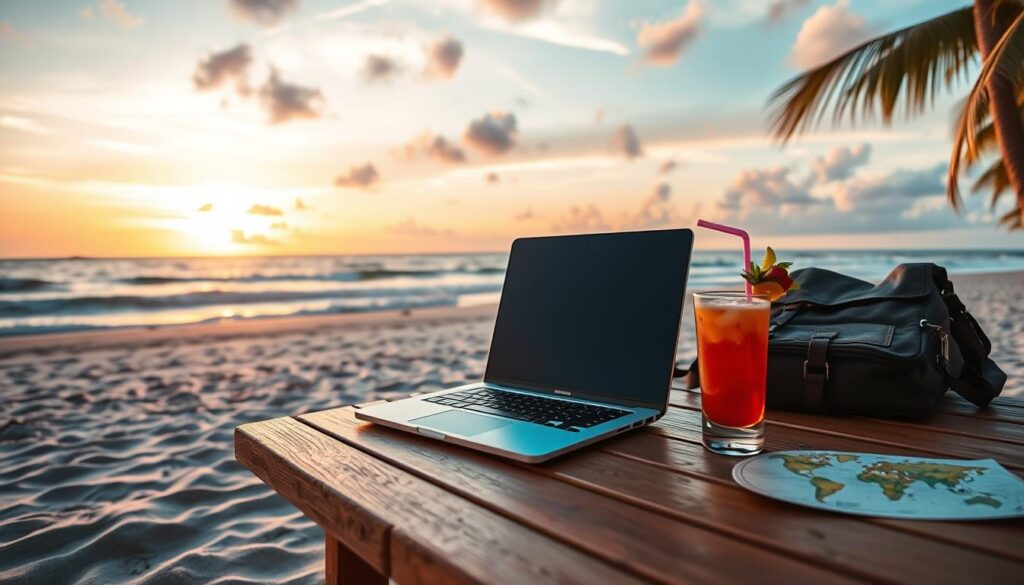
The transition from traditional work to digital freedom signifies a fundamental shift in how people approach work and life, with a focus on personal fulfillment, flexibility, and the pursuit of one’s passions. As the online entrepreneur lifestyle continues to evolve, more individuals are embracing this transformative path, unlocking a world of opportunities for work-life balance and global exploration.
Building a Sustainable Digital Nomad Business Model
Embracing the digital nomad lifestyle often requires crafting a sustainable business model that supports your personal and professional goals. Successful digital nomad entrepreneurs leverage essential tools and platforms to streamline remote operations, manage diverse time zones and remote teams, and strategize their finances to capitalize on the benefits of geoarbitrage.
Essential Tools and Platforms for Remote Operations
To facilitate a smooth digital nomad experience, entrepreneurs rely on platforms like Airbnb and Hostelworld for booking accommodations, and apps such as Croissant and Deskpass to find suitable co-working spaces. These tools help digital nomads seamlessly coordinate their mobile lifestyles while maintaining productivity and efficiency.
Managing Time Zones and Remote Teams
Managing time zones and remote teams is a crucial aspect of building a sustainable digital nomad business model. Effective communication and project management tools, such as Slack, Trello, and Asana, are vital to ensuring seamless collaboration, task delegation, and progress tracking across dispersed teams.
Financial Strategies and Geoarbitrage Benefits
Financial strategies for digital nomad entrepreneurs often involve the concept of geoarbitrage, where individuals earn in stronger currencies and spend in countries with a lower cost of living. This strategic approach can significantly accelerate savings and potentially lead to earlier retirement, as exemplified by Kristin Addis, who was able to retire at the age of 35 by leveraging geoarbitrage.
By adopting a sustainable digital nomad business model, entrepreneurs can unlock the full potential of their location-independent lifestyles, balancing personal fulfillment with professional success in the ever-evolving landscape of remote work and entrepreneurship.
Conclusion
The rise of digital nomadism represents a fundamental shift towards a more interconnected and liberated workforce. This online entrepreneur lifestyle offers entrepreneurs the freedom to work from anywhere, set their own hours, and build location-independent income streams while exploring the world. However, it also comes with challenges that require adaptability, self-discipline, and effective use of technology.
As the trend of digital nomadism continues to grow, it’s reshaping not only how individuals work but also how businesses operate and how countries attract talent. The future of work is increasingly flexible, global, and driven by technology, with online entrepreneurs at the forefront of this evolution. By embracing the principles of remote work freedom, these digital nomads are redefining the boundaries of traditional entrepreneurship and paving the way for a more fulfilling and sustainable work-life balance.
Ultimately, the transition to a digital nomad lifestyle is a testament to the power of technology, the desire for personal fulfillment, and the growing importance of work-life harmony in the modern business landscape. As the world continues to evolve, the online entrepreneur lifestyle will undoubtedly play a crucial role in shaping the future of work and empowering individuals to achieve their dreams of freedom and personal growth.