
Maintaining sharp mental focus is more critical than ever. We constantly seek reliable support for our cognitive engine, especially under pressure.
This vital compound is synthesized naturally from arginine, glycine, and methionine. This two-step reaction involves enzymes called AGAT and GAMT.
Our exploration dives into the latest scientific evidence. We examine how supplementation influences mental clarity and energy metabolism within your mind.
By analyzing data from 281 individuals across six clinical studies, we provide a clear overview. This research highlights tangible impacts on cognitive performance and systemic effects.
Historically, the focus was on skeletal muscle. Now, its emerging role in neuroprotection takes center stage for long-term wellness.
Our goal is to empower you. We break down complex biochemistry into actionable insights for your daily routine.
This guide serves as a foundational resource. It is designed for independent professionals pursuing optimized mental energy and resilience.
If you’d like to learn more about how creatine helps men’s brain function and optimization, you can discuss it in your coaching with John.
Key Takeaways
- Creatine is a naturally produced compound essential for cognitive support.
- Its synthesis relies on specific amino acids and enzymatic reactions.
- Clinical data from hundreds of participants shows positive effects on mental performance.
- The focus of research has shifted from muscle to brain cell protection.
- Understanding these processes enables informed choices about supplementation.
- This knowledge is key to optimizing your mental energy and long-term resilience.
- We translate complex science into clear, practical guidance.
Introduction to Creatine and Brain Function
The human mind, while only a fraction of body weight, commands a disproportionate share of our daily energy budget. This intense metabolic need makes it a primary target for any strategy aimed at optimizing cognitive performance.
| Metric | Brain | Rest of Body |
|---|---|---|
| Percentage of Body Mass | ~2% | ~98% |
| Percentage of Resting Energy Use | ~20% | ~80% |
We define this key compound as a naturally occurring nitrogenous substance. Its critical function is to maintain the high-energy demands of neuronal operations. Pioneering work by Wyss and Kaddurah-Daouk established that neurons require a constant ATP supply.
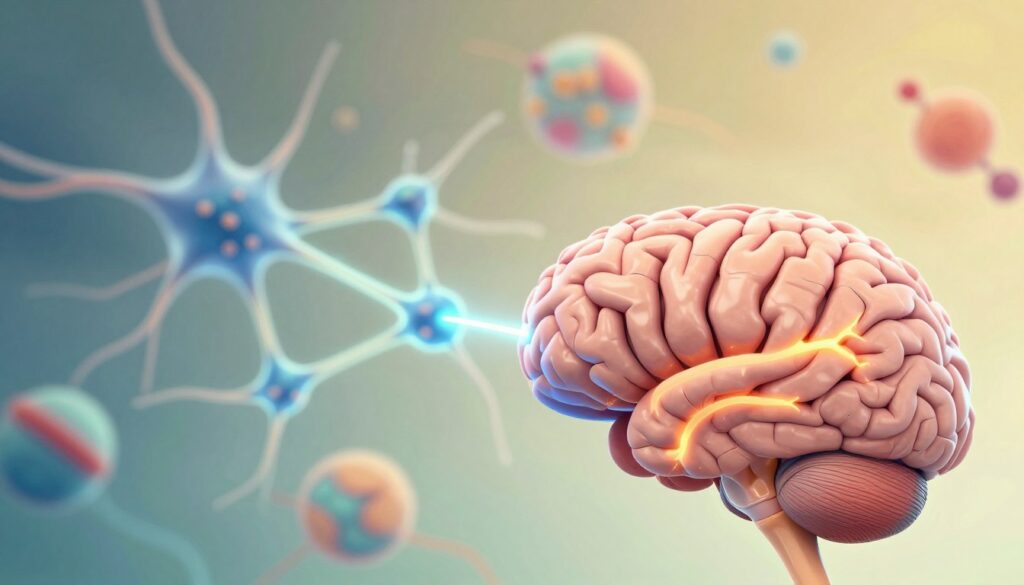
Understanding this compound’s role means looking at the creatine kinase system. This enzyme interaction rapidly regenerates ATP during periods of high stress or demand. It’s a critical recycling mechanism for your mental engine.
Modern lifestyles, full of pressure and complex tasks, force us to examine how we fuel cognition. This article sets the stage for a deep dive into the biochemical pathways. We will explore how targeted supplementation can support improved mental output and focus.
The Science Behind Creatine and Cognitive Performance
Your ability to think clearly under pressure hinges on a biochemical reserve tank that refuels your neurons in milliseconds. This system is the foundation for sharp cognitive performance.
We must first understand the immense energy cost of thought. Goal-directed tasks make your mind’s metabolic rate soar.
Energy Metabolism in the Brain
Neurons are power-hungry. They consume about one-fifth of your body’s resting energy output.
This demand necessitates a robust, near-instantaneous method for ATP regeneration. Slower pathways cannot keep up during intense focus.
Role of Phosphocreatine in Neuronal Function
Here is where phosphocreatine becomes critical. It acts as a high-energy phosphate buffer.
This compound rapidly donates a phosphate group to ADP, recreating ATP. The creatine kinase enzyme catalyzes this vital reaction.
This process provides a temporal and spatial energy reserve. It ensures consistent fuel for synaptic firing and neurotransmitter release.
Our analysis confirms this regeneration is significantly faster than glycolytic methods. Maintaining this optimal energy metabolism is a cornerstone of high-level performance for active adults.
Understanding Creatine Supplementation Forms
The quest for optimal cognitive support often leads to a critical question: which form delivers real benefits? We see countless products making bold claims.
Scientific consensus provides a clear answer. Creatine monohydrate is the most bioavailable and effective formulation. It consistently increases plasma and tissue levels for reliable results.
Other variants, like ethyl-ester or liquid forms, are heavily marketed. Their actual absorption rates often fail to match the hype. Bioavailability dictates how quickly this compound reaches its targets.
We empower you to navigate this landscape with confidence. Focus on the well-researched, standard monohydrate for proven efficacy and safety. This choice supports both physical and mental performance goals effectively.
Creatine for Brain Health
Landmark research from the late 1990s provided the first clear evidence that our cognitive energy reserves can be augmented. We examine the pivotal data and practical protocols that shape modern understanding.
Key Research Findings on Brain Creatine Levels
The 1999 investigation by Dechent et al. was a turning point. Using phosphorus magnetic resonance spectroscopy, they tracked changes in the thalamus and white matter.
A daily dose of 20g of creatine monohydrate for four weeks raised total cerebral phosphagen stores by 8.7%. This proved the central nervous system is responsive to supplementation.
Our review of six clinical trials, involving 281 people, supports this. Consistent administration linked to improvements in short-term memory and intelligence test scores.
It’s crucial to note the increase in mental tissue is often more modest than in muscle. This highlights the unique regulatory environment of the cranium.
| Study | Supplementation Protocol | Change in Brain Creatine Levels | Noted Cognitive Effect |
|---|---|---|---|
| Dechent et al. (1999) | 20g creatine monohydrate daily for 4 weeks | +8.7% (total) | Not measured in this trial |
| Rawson et al. (2008) | ~0.03g/kg body weight daily (approx. 2g) | Measured | Improved performance on complex tasks |
| Aggregate of 6 Studies | Various doses (2g-20g daily) | Positive increase | Enhanced short-term memory & reasoning |
Supplementation Protocols and Dosages
Rawson’s 2008 work examined a lower, sustained dose. It showed that even moderate daily intake could influence task performance in young adults.
Our analysis suggests that more significant shifts in cerebral bioenergetics may require higher or longer-term protocols. The mind’s ability to store and utilize this compound directly influences cognitive output.
We provide a balanced view. Different dosages offer varied timelines for achieving optimal support for your mental function.
Impact of Dietary Creatine and Vegetarian Considerations
For individuals on plant-based diets, the conversation around cognitive support takes on a unique dimension. Your dietary framework directly sets your baseline for critical energy reserves.
We see a clear biochemical divide. Those excluding meat and seafood typically show about 30% lower intramuscular creatine content. This gap influences how your system responds to external support.
Research by Watt and colleagues in 2004 highlights this. Vegetarians demonstrated a more pronounced response to supplementation. Their lower initial stores created greater potential for increase.
Comparing Meat Eaters and Vegetarians
These baseline differences shape outcomes in clinical trials. Individuals following plant-based diets often experience more significant improvements in memory tasks. Their starting point is simply lower.
Achieving therapeutic levels through food alone is highly impractical. It would require consuming massive quantities of meat daily. Strategic supplementation becomes the sensible pathway.
We empower you with this insight. If you follow a vegetarian or vegan lifestyle, targeted strategies can effectively optimize your mental performance. It’s about working with your body’s unique biochemistry.
Creatine Deficiency Syndromes and Cognitive Implications
The most profound evidence for a compound’s essential role often comes not from its benefits, but from the severe consequences of its absence. We gain critical insight from rare, inherited metabolic conditions.
Genetic Disorders Affecting Creatine Synthesis
Specific genetic errors disrupt the body’s ability to produce or transport this vital phosphagen. Disorders like AGAT, GAMT, or SLC6A8 deficiency are characterized by global developmental delay and profound intellectual disability.
These syndromes highlight a non-negotiable truth. Adequate cerebral levels are fundamental for normal neural development and cognitive function.
The SLC6A8 transporter is particularly crucial. It distributes the compound from circulation into the mind and other tissues. A fault here blocks delivery entirely.
Research by Braissant et al. in 2011 showed oral supplementation could partially reverse effects in AGAT and GAMT cases. This intervention supports the affected biochemical pathway directly.
Our analysis underscores the necessity of early diagnosis and intervention for these impactful deficiency syndromes. They provide a unique window into the compound’s indispensable role.
For long-term cognitive wellness, maintaining a robust metabolic system is essential. These clinical conditions offer a powerful lesson for everyone.
Effects of Creatine on Short-Term and Long-Term Memory
Evidence from controlled trials points to a measurable link between cerebral energy reserves and memory task outcomes. A pivotal study by McMorris and colleagues in 2007 found that administration of this compound significantly boosted long-term memory in healthy adults compared to a placebo.
Our analysis shows spatial memory and rapid memory scanning tasks often show a positive response. Several randomized controlled trials report improvements in these specific domains following a supplementation protocol.
However, results across different cognitive tests can be conflicting. Some studies reporting benefits have been flagged for a high risk of bias in their methodology. This highlights a need for cautious interpretation of early findings.
We aim to clarify how this phosphagen influences neural pathways for encoding and retrieving information. Enhanced cellular energy levels may support the synaptic plasticity required for solid recall and retention.
| Study | Memory Domain Tested | Supplement Protocol | Key Outcome |
|---|---|---|---|
| McMorris et al. (2007a) | Long-term Verbal & Spatial | 20g daily for 7 days | Significant improvement vs. placebo |
| Rawson et al. (2008) | Working Memory Scanning | ~2g daily for 6 weeks | Improved task speed & accuracy |
| Watanabe et al. (2002) | Short-term Recall | Single 8g dose | No significant effect observed |
The current data is promising but not definitive. We emphasize the necessity for larger, more robust research to confirm how reliably this strategy can boost performance in diverse groups.
Creatine’s Influence on Executive Function and Attention
Executive function acts as the CEO of your cognition, directing resources where they’re needed most under pressure. This suite manages complex planning, focused attention, and impulse control.
We examine how strategic support can optimize these high-demand mental operations. Enhanced cellular energy availability is key for superior cognitive performance.
Cognitive Task Performance in Clinical Trials
Ling et al. (2009) observed improved performance in response inhibition and number-pair matching tasks. This controlled study highlights the compound’s potential to sharpen mental agility.
Our review of this and other studies shows clear benefits for rapid information processing. However, results on sustained attention are conflicting. Some trials report significant gains, while others find no change.
Mental fatigue, a common barrier during intense effort, may be mitigated through this approach. Strategic supplementation appears most effective for tasks requiring high focus and swift decision-making.
We provide a critical look at the methodologies. Understanding the evidence strength helps you make informed choices for your cognitive performance goals.
The Role of Creatine in Counteracting Sleep Deprivation
When sleep is scarce, our mental resources face a severe metabolic challenge. This state depletes cerebral energy stores and impairs overall cognitive performance.
We examine the pivotal 2024 study by Gordji-Nejad et al. It showed a single 0.35g/kg dose of creatine improves processing speed during extended wakefulness.
Studies on Single-Dose Effects Under Sleep Loss
This research highlights how acute supplementation can reverse metabolic alterations from 21 hours without sleep. The compound helps maintain pH levels and phosphate balance in the brain.
Our analysis suggests it prevents fatigue-related deterioration in subjects. Professionals with irregular schedules may find this strategy protective.
The study used 31P-MRS scans to track positive changes in cerebral metabolites. This offers a clear view of the rapid effects.
We note these results are promising but preliminary. Further studies are needed to understand long-term implications for sleep loss countermeasures.
Creatine Supplementation and Neuroprotection
Modern neuroscience is uncovering a compelling role for this phosphagen in defending the central nervous system against metabolic insults. We investigate its ability to shield neural tissue from harm by improving energy supply during periods of stress.
Our review highlights how this compound stabilizes mitochondrial function. This action helps prevent cellular damage within the mind’s intricate networks.
This strategy acts as a buffer against excitotoxicity. Such toxicity often follows traumatic injury or prolonged oxygen deprivation.
We discuss its role in supporting neuronal plasticity. This is essential for learning, memory, and recovery from neurological challenges.
Maintaining ATP levels through creatine kinase activity is crucial. It prevents the cascade of events that can lead to neuronal cell death.
Researchers show growing interest in creatine as a potential adjunctive therapy. It may support various neurodegenerative conditions.
Our goal is to explain why proactive supplementation builds an energy reserve. This reserve protects against future metabolic challenges and optimizes long-term performance.
Clinical studies and a pivotal study point toward this protective effect. We empower you with insights for building cognitive resilience.
Research Insights from Randomized Controlled Trials
To separate genuine cognitive benefits from placebo effects, researchers rely on a specific gold-standard methodology. We examine the framework that gives scientific weight to claims about mental enhancement from compounds like creatine.
Our analysis begins with the core design principle: the double-blind, placebo-controlled trial. This approach minimizes bias and establishes true cause-and-effect relationships.
Methodologies and Outcome Measures
We apply tools like the Cochrane Collaboration’s risk of bias assessment to evaluate existing studies. This systematic review method highlights the reliability of different research findings.
Following PRISMA guidelines ensures comprehensive and transparent literature analysis. It allows us to present a clear overview of the evidence landscape.
Measuring cognitive change presents unique challenges. Scientists use standardized tests like Raven’s Advanced Progressive Matrices and digit span tasks to gauge specific mental function.
Controlling for variables is crucial. Baseline diet, age, and physical activity levels can all influence how an individual responds to supplementation. Each study must account for this variability.
Task performance metrics are key outcomes. Researchers define success through statistically significant improvements in these scores, providing a concrete measure of impact.
Understanding these methodologies empowers you. You can discern which trial results are robust and which require further verification in the scientific community.
The Biochemistry of Creatine Transport and Brain Uptake
The journey from bloodstream to neuron is a tightly regulated process governed by specific molecular gatekeepers. We examine the sophisticated system that controls creatine flow into neural tissue.
Function of the Creatine Transporter (SLC6A8)
A specialized protein called SLC6A8 acts as the primary gatekeeper. This transporter is expressed in the blood-brain barrier but often operates near saturation.
It regulates movement from circulation into the mind. Neurons can also synthesize this compound internally, providing independence during low availability.
Limitations of Blood-Brain Barrier Uptake
Our analysis shows this biological barrier presents a significant challenge. Exogenous uptake is limited compared to skeletal muscle.
Plasma levels, normally around 50 µmol/L, can increase significantly after ingestion. Yet cerebral uptake remains tightly controlled by kinetic factors.
The creatine transporter works at near-maximum capacity under normal conditions. This saturation point restricts rapid influx.
We explain why prolonged supplementation is often required for detectable changes. Effective protocols must account for these transport limitations to support cognitive function.
Optimal Dosing Strategies for Enhanced Cognitive Performance
Emerging data points toward a key insight: higher and longer dosing may unlock the full potential for mental support.
Our analysis suggests the cerebral environment is resistant to quick changes. Meaningful shifts in bioenergetics require a committed, strategic approach.
Preliminary evidence confirms this. Significant increases in phosphagen levels often need sustained, higher-dose protocols.
We must also consider the body’s adaptive response. Long-term, high-dose intake can trigger compensatory downregulation of natural synthesis.
This balance is crucial for lasting efficacy. Your protocol should aim to maximize reserves without disrupting your system’s innate rhythms.
| Protocol Strategy | Typical Dosage Range | Primary Goal | Key Consideration |
|---|---|---|---|
| High-Intensity Short-Term | 15g – 20g daily | Rapidly saturate tissue stores | May cause digestive discomfort; not typically needed for cognitive aims. |
| Moderate Sustained | 3g – 5g daily | Gradually elevate cerebral levels over months | Well-tolerated; aligns with the brain’s slower uptake kinetics. |
| Individualized | Based on body mass & diet | Personalized optimization | Accounts for baseline status (e.g., vegetarian diet) for a tailored effect. |
We empower you with practical guidance. Consistency and patience are non-negotiable for cognitive benefits. Benefits for cognitive performance accumulate over time.
The optimal protocol for enhancement is still being refined by ongoing studies. Individual responses will vary based on your unique baseline.
Our goal is to help you find a safe, effective balance. This strategy supports long-term mental function and resilience.
Creatine’s Application in Neurodegenerative and Mental Health Conditions
Scientific inquiry is now pivoting to see if boosting cellular energy reserves can offer tangible support in Alzheimer’s disease and mood disorders. This is a pressing topic, with projections showing over 15 million Americans may be affected by Alzheimer’s by 2050.
We examine how metabolic strategies could transform clinical management for these complex conditions.
Implications for Alzheimer’s Disease
This devastating condition is marked by a profound bioenergetic decline in the mind. Addressing this deficit is a key therapeutic target.
Our review of a pilot study by Smith et al. (2020) is revealing. A protocol of 20g per day led to improved cognitive outcomes in patients.
This suggests high-dose supplementation is a feasible adjunctive therapy. It could help individuals who see limited benefits from standard treatments alone.
Potential Benefits for Mood Disorders
Research also points to a role in mental wellness. A large analysis of 22,692 U.S. adults found an inverse link between dietary intake and depression.
Lower frontal lobe phosphocreatine levels are correlated with higher depression scores. This highlights a potential pathway for mood regulation.
We analyze how supporting cerebral energy metabolism could aid emotional function. It provides a hopeful look at future metabolic interventions for mental health.
Future Directions and Ongoing Research in Creatine Supplementation
Looking forward, the scientific community is poised to tackle the most pressing unknowns in metabolic support for cognitive function. We need larger, multi-center studies to confirm the initial benefits observed in smaller trials.
This will help establish definitive protocols for diverse groups. Our goal is to move beyond promising pilot data toward widely applicable strategies.
Novel delivery methods represent a thrilling frontier. Intranasal administration is being explored to bypass the blood-brain barrier entirely.
This could revolutionize how we support cerebral energy levels. It addresses a key limitation of current oral supplementation.
Future studies must also examine how this compound interacts with exercise and nutrition. Optimizing mental wellness is a holistic endeavor.
We emphasize the critical need for long-term safety data. Understanding the effects of sustained, high-dose protocols is essential for public trust.
Our mission is to keep you informed as this field evolves. We champion a proactive, evidence-based approach to cognitive performance and resilience.
Conclusion
The evidence we’ve reviewed paints a clear picture: optimizing your metabolic reserves is key to cognitive vitality. This compound’s role extends far beyond muscle, serving as a critical support for neuronal function and mental resilience.
Consistent, high-quality supplementation helps maintain optimal phosphagen levels. This is especially valuable during periods of intense focus or metabolic demand.
Understanding this science empowers you. You can now make informed choices that align with your long-term goals for clarity and wellness.
We encourage you to view metabolic strategies as part of a broader journey toward autonomy. Thank you for exploring this fascinating frontier with us.