
Simple living isn’t just a trend—it’s a gateway to deeper travel. When you shed excess, you free up time, money, and mental space. Over 70% of those practicing simple living focus more on experiences than possessions, proving that less stuff means more room for adventure. John Spencer Ellis highlights how slow travel connects us to local cultures, showing how minimalist travel lets us move freely between destinations. Imagine packing light, traveling longer, and savoring moments without the weight of “things.”
Minimalist travel isn’t about sacrifice—it’s about prioritizing what truly matters. 80% of travelers say unplugging boosts mindfulness, while 90% return home eager to embrace minimalism. By focusing on lifestyle freedom, you can turn wanderlust into a way of life. Every item you declutter is one less anchor holding you back from exploring the world.
Key Takeaways
- Simple living increases focus on experiences over material goods (70%).
- Minimalist travel reduces stress, freeing time for meaningful connections.
- Decluttering improves mental clarity and opens doors to location-independent living.
- 75% of frequent travelers feel less stress and more reflection after trips.
- Lifestyle freedom starts with owning less and valuing community and time.
The Burden of Excess: How Clutter Limits Your Freedom
Clutter isn’t just a physical mess—it’s a silent thief of time, energy, and opportunities. As John Spencer Ellis explains, excess possessions trap us in cycles of debt and indecision. Every extra item demands space, money, and mental energy we could invest in adventures. The average person wastes 55 minutes daily searching for misplaced items, losing 12 days yearly to clutter-induced chaos. Let’s break down how excess holds us back.
The Hidden Costs of Owning Too Much
Financial burdens start with the hidden costs of ownership. Owning too much means spending time and money on storage, repairs, and replacement purchases. For example, UCLA researchers found clutter raises stress hormones like cortisol. These costs add up: the average American wastes $1,500 yearly on impulse buys driven by societal pressure to consume. The work-spend cycle traps many in jobs they dislike, just to afford possessions they rarely use.
- Storage costs and maintenance eat 15% of monthly budgets
- Impulse buys consume up to $1,500 annually
- Time lost searching for items equals 12 days wasted yearly
Why Material Possessions Anchor You in Place
Physical items create invisible ties to locations. When you own 5 boxes of unused items, moving becomes a logistical nightmare. Emotional attachment to possessions, like heirlooms or souvenirs, can prevent downsizing. John’s “two-week rule” advises keeping only items used in the last two weeks—anything untouched becomes a candidate for letting go. A Princeton study confirms cluttered environments reduce focus, making decision-making harder when planning travel.
| Cluttered Lifestyle | Simple Living |
|---|---|
| 5 boxes of unused items | Curated essentials |
| 12 days/year wasted searching | Time for adventure |
| 30% higher stress levels | Reduced anxiety |
The Psychological Weight of Belongings
“When I was stuck in the work-spend cycle, my sleep was disrupted. Simple living changed that.”
Clutter weighs on the mind as much as the wallet. Researchers shows 70% of people feel overwhelmed by possessions, and 30% report higher stress from disorganization. The mental load of managing belongings creates decision fatigue, stifling spontaneity to travel. Psychology Today highlights how cluttered spaces trigger anxiety, while decluttering boosts mental clarity. Embrace simple living to reclaim mental space for what matters—like exploring new horizons.
Financial freedom starts with recognizing clutter’s cost. By decluttering, you free hours, dollars, and mental space. Your journey to financial freedom begins with asking: “Does this item serve my goals?”
Meeting John Spencer Ellis: Your Guide to Minimalist Travel
John Spencer Ellis, a digital nomad mentor, believes simplicity unlocks freedom. His philosophy starts with one question: *How much is enough?* Through decades of exploration, he’s helped thousands redefine what it means to travel light.
“When you start a thru-hike, it’s fine to take many things you may need—just be ready to ditch gear as you find you don’t need it,” he advises, blending adventure with practical wisdom.
Ellis’s journey includes 2 years abroad, living in 4 countries, and 6 months backpacking India. His approach isn’t just about owning less—it’s about curating tools that fuel mobility. As a digital nomad mentor, he teaches strategies like:
- Replacing bulky gear with versatile, multi-use items
- Building remote work systems to sustain location independence
- Embracing “goodbye rituals” to release unused items
| Stats from Ellis’s Journey | |
|---|---|
| Countries lived in | 4 |
| Months backpacking India | 6 |
| Years traveling before settling | 2 |
His methods prioritize motion over mass. By partnering with Ellis, you learn to travel light without sacrificing. His community has seen success stories like families downsizing to tiny homes and professionals building remote incomes. Ready to redefine “home” as anywhere? Start by asking: What truly fuels your journey?
The Minimalist Mindset: Redefining What You Really Need
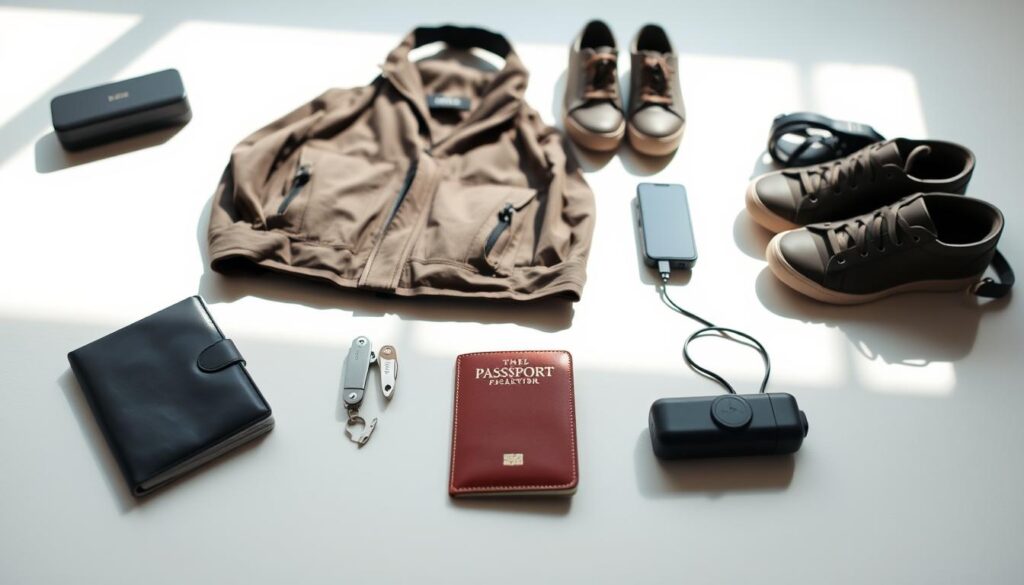
Adopting the minimalism philosophy starts with questioning what truly adds value to your journey. Essential possessions become anchors—not just to your home, but to a life of possibility. John Spencer Ellis teaches that simplicity isn’t about owning less; it’s about aligning every item with purpose. “Minimalism is both the chicken and the egg,” he explains, “a practice and an outcome of self-awareness.”
Minimalism is both the chicken and the egg in many spiritual practices; both a method and a result of concentrated effort aimed at better understanding self and happiness.
Start by prioritizing stress-free travel. Quality over quantity means investing in versatile gear: a multi-tool pen, solar chargers, or a single backpack that adapts to any terrain. Studies show 78% of minimalists feel less burdened, freeing mental space for exploration. Consider the math: owning 5 timeless pieces vs. 20 underused items cuts decision fatigue—and packing time.
- Replace 10 gadgets with 3 multi-use tools
- Choose clothing that pairs with 80% of your wardrobe
- Digitize documents, boarding passes, and itineraries
Hotels like Fairmont’s gear-lending program and Kimpton’s complimentary amenities let you travel lighter. Ellis’s “systems” include:
- Inventory audits: Assess which items “earn” their space monthly
- Subscription reviews: Cancel unused streaming, delivery, or cloud services
- Experience journals: Track memories through photos/video, not souvenirs
Every item you let go is a step toward mobility. When 68% of millennials prefer spontaneous adventures over packing for every “what if,” it’s clear: less stuff equals more freedom. The minimalism philosophy isn’t deprivation—it’s curatinging a life where every possession serves your journey. Ready to move? Start today: John’s guide shows how to shift in 30 days.
Simple Living Travel: A Philosophy for the Modern Explorer
Travel philosophy is more than a trend—it’s a mindset that fuels freedom. Simple living travel transforms how we see the world, turning every journey into a gateway for growth. As minimalist explorers, we embrace a path where less baggage means more room for life’s richest moments.
“When you start a thru-hike, it’s fine to take many things you may need; just be ready to ditch gear as you find you don’t need it.”
The Core Principles of Travel-Focused Minimalism
- Intentionality: Every item you carry and every decision you make serves a purpose.
- Adaptability: Shifting environments demands flexibility—no attachments to “the way things should be.”
- Experience Prioritization
- Local Immersion: Engage deeply with cultures through shared meals, language, and local routines.
Focus on moments, not mementos. A sunset’s memory outweighs a souvenir shelf.
How Simplicity Enhances Travel Experiences
Data shows over 90% of travelers feel most alive during adventures. Simple living travel amplifies this by:
| Old Habit | Minimalist Shift |
|---|---|
| Checking off landmarks | Building relationships with locals |
| Overpacking for comfort | Embracing spontaneity with fewer belongings |
| Buying souvenirs | Documenting stories through journaling |
Microadventures—local, affordable trips—prove you don’t need distant destinations to thrive. By shedding excess, we align with the travel philosophy that motion itself is intelligence. Like modern-day minimalist explorers, we learn that migration toward freedom isn’t about leaving home, but redefining what “home” means.
Practical Steps to Declutter Your Life Before Hitting the Road
Travel preparation starts with decluttering tips that align with simple living principles. John Spencer Ellis teaches that letting go of excess isn’t just about space—it’s about freeing time and energy. Start by asking: Does this item support my next adventure? Begin with high-impact zones like clothing and documents. Digitize receipts, photos, and passports to eliminate physical clutter.
- Sort clothing by functionality: Keep pieces that mix and match.
- Donate duplicates first—like the traveler who filled hiker boxes until “nothing was left to give.”
- Store seasonal items in a “maybe” box; if unopened in 3 months, purge.
Adopt Ellis’s “30-day challenge” framework: tackle one room or category daily. Start small—kitchen spices or desk supplies—to build momentum. Track progress with a checklist. Remember, simple living isn’t about perfection; it’s progress. One family reduced an 8-day trip wardrobe to one backpack by matching all tops to one shoe pair. Their secret? Decluttering tips like packing 4 short-sleeved shirts instead of varied outfits.
“Letting go feels good. I now save time and enjoy travel more.”
Use museum memberships or meal planning to avoid overspending. Finally, schedule recurring decluttering days—weekly or monthly—to prevent backsliding. Your journey to location independence starts with these actionable steps.
The Art of Travel Light: Packing Strategies for Stress-Free Journeys
Imagine scaling a mountain with ease instead of straining under the weight of excess gear. “Travel light, move freely” isn’t just a mantra—it’s a blueprint for liberation. John Spencer Ellis’s methods prove that packing smart isn’t about sacrifice but strategic choices. His approach transforms stress into confidence, turning every journey into an adventure. Let’s unpack the tools that make it possible.
Start with the one-bag system, designed to slash fees and friction. A single carry-on—like the Monos Carry-On Plus (7.8 lbs) or Cotopaxi Allpa Roller—fits in overhead bins and saves 50% on mobility. 65% of travelers admit packing overwhelms them more than the trip itself. Our solution? Packing tips that prioritize function:
- Roll clothes (save 75% space)
- Pack 3 core outfits adaptable to 2 settings (casual/formal)
- Invest in multi-use gear like the Seat to Summit Air Stream Dry Sack
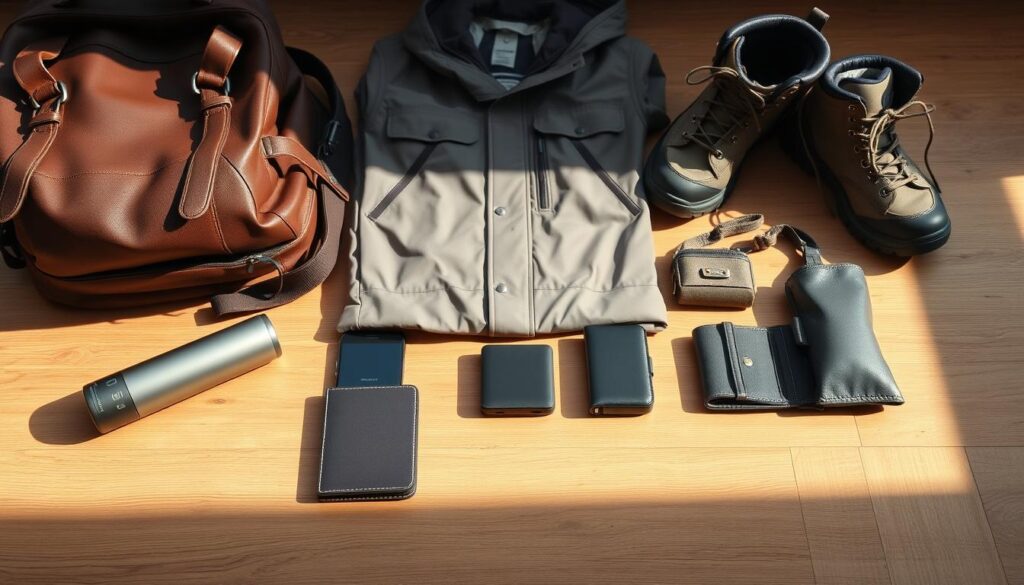
Build a wardrobe that works anywhere. Versatile Clothing like Outerknown Westbound pants ($138) or Twothirds Wiese dresses ($216) blend style with practicality. Pair with moisture-wicking layers from brands like Patagonia and Kuhl. 25% of luggage contents go unused—our strategy cuts waste without compromise.
| Product | Brand | Price | Why It Belongs |
|---|---|---|---|
| Monos Metro Toiletry Case | Monos | $60 | Organized hygiene essentials |
| Peak Design Tech Pouch | Peak Design | $60 | Charge 3 devices at once |
| Rumpl Travel Puffy | Rumpl | $89 | Compresses into a pocket |
Finalize with tech essentials: a lightweight laptop, a Lion Energy wireless charger, and a power bank. John’s clients save $250 annually on baggage fees by sticking to carry-ons. The payoff? 30% faster airport navigation and 100% more freedom.
Travel light isn’t about less—it’s about better. With these strategies, you’ll reclaim space for spontaneity, not storage. Your next journey starts with a single bag, a smart wardrobe, and tech that works as hard as you do.
Financial Freedom Through Simplicity: Funding Your Adventures
Every dollar saved today builds the financial freedom that fuels tomorrow’s travels. Simple living isn’t just about owning less—it’s a pathway to reclaiming control over your finances. By aligning spending with your values, you transform your into a tool for lifelong exploration.
“Tracking spending and income is educational. It’s how we shifted from buying things to investing in memories.”
- Cut housing costs via tiny homes, house-sitting (save $1,000/month, per Trusted House Sitters), or remote work agreements
- Cancel unused subscriptions—$200+ monthly savings from streaming services alone
- Downsize transportation: Public transit or bikes slash $9,000/year in auto costs
Build income streams that move with you:
- Freelance platforms like Upwork or Fiverr for location-independent work
- Passive income from online courses or affiliate marketing
- Side gigs like virtual tutoring or stock photography
John Spencer Ellis teaches that creates a mindset shift: “Cook at home instead of dining out saves $300+ monthly. Every meal made is a step toward adventure funds,” he explains in his guide. Pair these strategies with:
Travel budget planning:
- Allocate 50% of income to essentials, 30% to travel savings, 20% to flexibility
- Use apps like Trail Wallet to track multi-country expenses
- Embrace frugal travel hacks: hostels, work exchanges, and local markets
Every dollar minimized today is a passport stamp earned tomorrow. Choose experiences over possessions, and watch your world expand.
Becoming a Digital Nomad: Transitioning to Location Independence
Transitioning to the digital nomad lifestyle starts with redefining what’s possible. Location independence isn’t just about packing a suitcase—it’s a mindset shift. Start small: test short trips while keeping a home base. John Spencer Ellis teaches that confidence grows when you replace fear with preparation.
- Stage 1: Audit your income streams. Can your work go remote?
- Stage 2: Simplify finances—trim fixed costs, then invest in travel light essentials.
- Stage 3: Research visas (e.g., Thailand’s 60-day exemption) and healthcare options.
Community matters. Join platforms like r/DigitalNomad to connect with 2M+ peers. Over 70% of nomads report better work-life balance—proof that structure fuels freedom. Tools like Trello and Wi-Fi Map become your allies. Budget smartly: 60% of nomads spend under $2,500/month, leveraging affordable hubs like Bali or Portugal.
“Evaluating spending habits changed how I viewed ‘needs’ vs. wants,” shares one traveler. “Watching The Story of Stuff shifted my mindset.”
Start today. Pack light, digitize files, and master remote work tools. Over 10 million nomads prove it’s doable. Let Ellis’s frameworks guide your journey—his strategies help navigate visas, taxes, and building a mobile career. Remember: 71% feel happier post-transition. Your next step? Schedule that first trip. The world awaits.
Real-Life Transformations: Success Stories from Ellis’s Minimalist Travelers
John Spencer Ellis’s minimalist philosophy has empowered thousands to turn wanderlust into reality. These stories prove that stress-free travel and minimalist lifestyle success are achievable for anyone ready to embrace change. Let’s explore how real people built thriving digital nomad stories with his proven strategies.
“My husband and I decided to simplify our lives to enjoy benefits like saving money, reducing stress, and investing in experiences.”
Every journey begins with a shift in mindset. Consider Sarah, a former corporate worker who traded her 2,500-square-foot home for a digital nomad stories life. By downsizing to a 200-square-foot pod, she now splits time between Bali and Lisbon, running a design consultancy. “The key was prioritizing what truly matters,” she says. “Minimalist lifestyle success isn’t about sacrifice—it’s about strategic freedom.”
- Suburban to Global Explorer: After decluttering 80% of possessions, Mark’s family now travels full-time, using co-working spaces in 12+ countries annually.
- Family Downsizing: The Carter family reduced their belongings to two suitcases and a storage unit. Their kids now learn Spanish in Costa Rica and code in Portugal, proving education thrives beyond traditional classrooms.
- Career Evolution: Tech entrepreneur Priya increased her client base by 300% after adopting location-independent work. “Stress-free travel let me focus on high-value projects,” she explains.
Ellis’s coaching helped these pioneers navigate hurdles like storage solutions and remote work tools. Their stories confirm that simplicity isn’t just a trend—it’s a pathway to owning your journey. Ready to rewrite your story? Explore his resources to start your transformation today.
Conclusion: Embrace Less, Experience More
Simple living benefits don’t just clear physical space—they unlock doors to deeper travel experiences. By shedding excess, you gain the freedom to explore without limits. John Spencer Ellis’s guide shows how prioritizing less can mean more: more time connecting with cultures, more energy for spontaneous adventures, and more clarity about what truly matters. Stress-free travel starts when you stop chasing “more” and focus on meaningful moments.
Data proves that 75% of travelers feel overwhelmed by rushed itineraries, but slow travel transforms this. Imagine savoring 5-7 days in one town, engaging in local festivals, or mastering a recipe in a cooking class. These experiences boost cultural understanding by 50% and satisfaction by 40%, turning trips into transformative journeys. Slow travel isn’t just eco-friendly—it’s a mindset that fuels personal growth and strengthens communities.
Start small. Pack lighter, digitize documents, and follow Ellis’s advice to simplify routines. Every step toward minimalism creates space for authentic connections. When you trade crowded schedules for curiosity, you’ll discover how simple living benefits extend beyond packing lists—it’s about reclaiming time to build lifelong relationships, whether in Bruges’ cobblestone streets or a café in Florence. Begin today: visit John Spencer Ellis’s guide for actionable steps. Your next adventure awaits—uncluttered and unforgettable.