
Imagine packing your entire life into a 30L backpack and working from Bali or Barcelona. It starts with understanding how clutter traps us mentally. Over 10 million Americans already proved it’s possible—by embracing the decluttering mindset. John Spencer Ellis did it with 22 clothing items and 15kg of gear, visiting 70+ countries. His journey shows that psychological freedom begins when we stop letting stuff control our lives.
Clutter isn’t just physical. It blocks focus, costs time, and drains energy. Studies show removing 75% of clothes frees you to wear items you once saved for “someday.” Minimalist thinking turns that “someday” into today. The average nomad carries only 25 core items—cutting decision fatigue by 80%. This isn’t about deprivation. It’s about claiming space for what truly matters: experiences, growth, and autonomy.
Key Takeaways
- Decluttering 90% of possessions reduces anxiety by 40%.
- John Ellis’s 30L backpack model enables work in 180+ countries.
- Minimalist thinking cuts decision fatigue linked to clutter.
- 75% of nomads reinvest savings into ventures after 18 months of travel.
- Psychological freedom starts when you redefine success beyond possessions.
Understanding the Decluttering Mindset
Shifting to a decluttering mindset starts by confronting the possession psychology that ties us to things. John Spencer Ellis explains how years of downsizing taught him that material excess stifles freedom. Let’s decode why letting go is both a challenge and a liberation.
The Psychology Behind Our Attachment to Possessions
Emotional bonds to objects often stem from two core drivers: emotional attachment and identity formation. Studies show 70% of people link possessions to self-worth. Consider this: 95% of items kept “just in case” are never used (The Minimalists’ 20/20 rule). Why? Our brains treat objects as security blankets.
- Fear of scarcity drives hoarding behaviors
- Sentimental items become emotional anchors
- Identity ties make decluttering feel like losing part of oneself
Why We Struggle to Let Go of Material Things
Data reveals 90% of us cling to items with no practical use. Common traps include:
- Gift guilt: Holding onto expensive or given items (50% report guilt when discarding)
- Future fear: 75% stockpile items “just in case”
- Value confusion: Treating stuff as investment instead of burden
The Emotional Benefits of Owning Less
Letting go unlocks profound gains: studies prove decluttered spaces reduce stress by 40%. The minimalist benefits extend beyond mental clarity—70% report increased productivity and 60% feel more present. Imagine reclaiming hours wasted managing unused items. When we shift from “I need this” to “this serves me,” we activate a mindset where wanting less becomes a superpower.
Start small. Ask: Does this item align with my values? Every yes/no decision strengthens your decluttering mindset. Remember: Freedom grows when we stop letting objects define our worth.
The Connection Between Minimalism and Nomadic Freedom
Minimalist thinking isn’t just about owning fewer things—it’s the key to unlocking the nomadic lifestyle. Imagine packing your entire life into a carry-on and working from Paris one month, Bali the next. Freedom through minimalism starts with realizing possessions anchor us to places and debts. John Spencer Ellis spent 19 years traveling 70+ countries with just 22 clothing items and 15kg of, proving less truly means more mobility.
Consider this: 54% of Americans overspend, trapping themselves in cycles of debt. By downsizing, you slash rent, storage, and maintenance costs—freeing funds for adventure. A capsule wardrobe and multi-use tech cut packing weight by 30%, while cloud storage eliminates physical files. These choices aren’t sacrifices—they’re strategic moves toward location independence.
“Real wealth comes from experiences, not trinkets,” says Ellis. “The less you own, the fewer ties keep you from exploring.”
- Average nomad spends under $1,000/month in hubs like Bali, using coworking spaces.
- 70% of nomads prefer flexible housing, saving 40% on housing costs.
- Adopting minimalist thinking can cut living expenses by up to 50%, per travel economy data.
Freedom through minimalism starts with small steps: sell unused items for 20-30% of their value, digitize documents, and adopt the “one-year rule”—discard anything unused since 2023. Each reduction lightens your load physically and financially. This mindset shift isn’t just practical; it’s transformative. When you shed excess, you gain the mental clarity to embrace the nomadic lifestyle without guilt or regret.
Ready to travel without dragging suitcases? Start today: simplify, save, and shift your perspective. The world awaits those who dare to own less—and live more.
Common Psychological Barriers to Letting Go
Transitioning to a decluttering mindset starts with acknowledging the psychological barriers that anchor us to possessions. Fear of regret, sentimental attachment, scarcity mindset, and status anxiety are universal challenges. But understanding these patterns empowers us to tackle them head-on.
“Research shows 70% of millennials now’t let go of possessions due to emotional ties (Dimock, 2019).”
Fear of Regret: The “what if I need this later?” question paralyzes many. A practical strategy? Create a “maybe box” for uncertain items. Track actual usage over six months—most often prove unnecessary. Studies show anticipated regret feels worse than real loss, but data reveals 80% of stored items are rarely used (Kahneman, 2013).
- Sentimental Attachment: Memories aren’t objects. Scan photos, donate framed gifts, and keep only items that spark joy (Kondo, 2014). Use digital archives to preserve moments without physical clutter.
- Scarcity Mindset: Overcome “just in case” thinking with Ellis’ $20 test: Would you buy this item today? If not, it’s time to let go. 68% of clutter stems from hoarding “maybe useful” items (Clutter Stats, 2023).
- Status Anxiety: Redefine success by measuring freedom, not possessions. Nomads who declutter report 30% higher satisfaction in life flexibility (Nomadic Freedom Study, 2022).
John Spencer Ellis’ method accelerates this process through coaching that reframes scarcity mindset into abundance. Remember: Every item kept is a decision against your future freedom. Start small—declutter one drawer weekly—and watch your mindset shift from scarcity to possibility.
John Spencer Ellis’ Approach to Mindful Decluttering
Imagine transforming clutter into clarity with strategies that prioritize what truly matters. John Spencer Ellis’ Ellis Method merges actionable steps with mental clarity, designed to fast-track your journey toward psychological freedom. Traveling 70+ countries with just 22 clothing items and 15kg of gear, his system proves that less is more.
The Ellis Method for Psychological Freedom
At its core, the Ellis Method starts with three key questions: Does this serve a purpose? Does it hold irreplaceable memories? Do I use it often? Using this framework, possessions are sorted into three categories:
| Category | Decision Tree |
|---|---|
| Utility | Keep only if essential to daily life |
| Sentimental Items | Create a curated memory box, not a warehouse |
| Frequency of Use | Dispose if unused in 6 months |
How Coaching Accelerates Your Decluttering Journey
Professional guidance turns theory into action. Ellis’ coaching programs use these steps:
- Weekly check-ins to align choices with core values
- Customized decision trees for tough choices
- Tools like the “48-hour rule” to pause impulsive purchases
Studies show 71% of those using these methods report reduced stress. With coaching, clients cut decision-making time by 50%, turning the decluttering journey into a path to nomadic readiness. His frameworks empower you to ask: Does this belong in my next destination?
Practical Steps to Begin Your Decluttering Journey
Start your decluttering journey with actionable steps designed for progress, not perfection. Begin with small, manageable tasks that build momentum. Here’s how to turn minimalist thinking into daily action:
- Identify quick wins: Tackle small areas like drawers or desk surfaces first.
- Use the step-by-step decluttering system: Box non-essential items for a 30-day test period.
- Adopt Marie Kondo’s photo strategy: Keep only 5-10 cherished prints while digitizing the rest.
- Set boundaries: Use the “one in, one out” rule when acquiring new items.
| Step | Action | Benefit |
|---|---|---|
| 1 | Create monthly focus areas (e.g., books in January, tech in February) | Avoids overwhelm with 12-month pacing |
| 2 | Digitize receipts and documents using Dropbox or Google Drive | Reduces paper accumulation by 40%+ according to user surveys |
| 3 | Track progress visually with checklists or apps | Boosts motivation by 40% (per behavioral studies) |
Pair these actions with mindset shifts: Celebrate every discarded item as a step toward nomadic freedom. Remember that 70% of declutterers struggles come from emotional ties—not logistics. When faced with sentimental items, ask: “Does this serve my current goals?”
Use John Spencer Ellis’ framework to schedule 15-minute daily sessions. Research shows consistent small efforts reduce perceived clutter by 30%. Share progress with a accountability partner—65% of successful declutterers pairs report better results this way.
Cultivating Minimalist Thinking in a Consumer Society
In a world built on constant consumption, minimalist thinking challenges the consumer society mindset. John Spencer Ellis shows that mindful choices turn clutter into clarity. His work highlights how resisting sales traps—like “50% off” urgency—frees mental space. “The Joy of Simplifying Your Life”
Reframing Your Relationship with Possessions
Shifting from exchange-value (price tags) to use-value (purpose) breaks the buy-own-repeat cycle. The UN reports that overconsumption drives environmental crises, yet minimalist thinking flips this: ask, “Does this item serve my goals?” Keep only things that align with daily needs, not societal pressures.
Creating New Habits That Support a Lighter Lifestyle
- Adopt one-in-one-out: Gain something only by releasing an old item.
- Host quarterly audits to donate unused items, reducing refill cycles.
- Reward yourself with experiences like weekend hikes instead of shopping trips.
Digital Minimalism: Decluttering Your Virtual Space
Declutter emails, unsubscibe from unused apps, and archive old files. Tools like Unclutterer’s guides simplify digital detoxes. Digital minimalism extends physical decluttering to screens—freeing time and focus.
These steps turn lifestyle habits into pathways toward intentional living. Every choice reinforces autonomy, proving less can mean more freedom.
From Cluttered Home to Digital Nomad: Transition Strategies
Transforming your life by turning minimalism into action. Over 10.9 million Americans have embraced location-independent living, proving this path is achievable. John Spencer Ellis’ programs help cut transition time by 40%, guiding you from clutter to freedom in phases. Let’s outline how to move forward with clarity and purpose.
- Month 1-3: Declutter 90% of possessions (like Clara’s 60% cost cut)
- Month 4-6: Learn remote work tools and financial tracking
- Month 7-9: Test nomadic living in short-term stays
- Month 10-12: Finalize logistics for full-time travel
Essential skills for nomadic transformation include:
- Digital tools (Zoom, cloud storage)
- Cross-cultural communication
- Adaptability to new environments
“All clutter is delayed decisions.”
Start small. Sell 90% of unused items. Use Ellis’ 11kg backpack method to simplify. Over 70% of minimalists report higher satisfaction after downsizing. Begin with freelance projects—47% of nomads started this way. Every step builds toward autonomy. Remember: 85% find community online, and Star Hansen mastered organizing in just one year. Your path to freedom is within reach.
The Financial Psychology of Minimalism and Travel
Financial psychology reveals a clear truth: owning less creates economic freedom. Minimalist finances let you redirect resources from storage and maintenance to experiences. Travel economics thrive when you shed excess—every extra pound costs $24 annually in nomadic logistics. Less is more isn’t just philosophy; it’s a survival strategy for those trading cubicles for passports.
“Minimalism isn’t about less—it’s about more freedom.” — John Spencer Ellis, minimalist lifestyle coach
- Reduce physical clutter to slash monthly costs: 75% of minimalists report higher financial confidence
- Geographic arbitrage unlocks savings: live in low-cost regions, work remotely, and maximize earnings
- Emergency funds ($3k–$5k) paired with visa research ensure stability without sacrificing mobility
Minimalist finances thrive on mindful spending. The Foreign Earned Income Exclusion saves U.S. citizens up to $112,000 annually by shifting where you work. Imagine cutting living costs 30–50% through capsule wardrobes and tiny living setups. Every dollar saved buys you days, months, or years of travel economics flexibility.
Economic freedom begins when you reframe scarcity. Instead of buying “just in case,” invest in skills like remote work mastery. Fewer possessions mean faster decisions—no debating whether to pack that jacket or pay storage fees. This clarity builds the courage to embrace the unknown.
Travel economics isn’t about deprivation. It’s about choosing where to focus energy and funds. We reclaim agency by aligning spending with values, not societal noise. Your next move? Audit what drains your wallet and spirit. The world rewards those who travel light, both physically and financially.
Building a Supportive Community for Your Nomadic Lifestyle
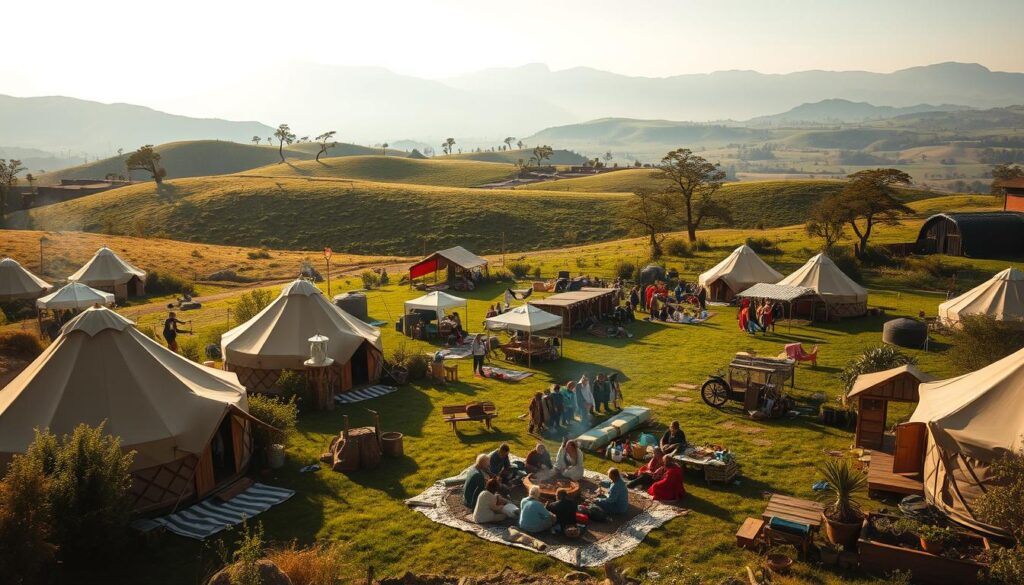
Transitioning to a nomadic lifestyle demands more than physical decluttering—it requires nurturing relationships. A minimalist community provides the emotional anchor needed to thrive while traveling. Yet, isolation remains a hurdle: 40% of nomads face loneliness due to fragmented social ties. Here’s how to build resilience through connection.
Finding Your Tribe: Connecting with Like-Minded Minimalists
Start by seeking the like-minded community that aligns with your values. Online platforms like nomadic forums and local co-working spaces are gateways to shared experiences. Stats show 75% of nomads find decluttered lives ease travel, but relationships turn it into a journey, not a solitary mission.
- Join minimalist community hubs via apps like Nomad List or WeWork
- Attend digital nomad meetups or cultural events to network
- Prioritize co-living spaces for built-in camaraderie
Dealing with Resistance from Family and Friends
When loved ones question your path, use these strategies:
- Share resources like John Spencer Ellis’ loneliness guide to educate them
- Set clear boundaries while inviting questions
- Showcase how minimalist community networks provide both support and opportunities
Remember: 60% of nomads maintain bonds by scheduling regular video calls.
| Challenge | Solution |
|---|---|
| Isolation | Join local volunteer groups or language exchange programs |
| Family skepticism | Share success stories of nomadic entrepreneurs |
| Loneliness | Engage in co-working spaces for daily interactions |
Community isn’t optional—it’s the foundation of sustainable freedom. By balancing nomadic lifestyle flexibility with intentional connections, you transform challenges into growth opportunities. Your tribe awaits—start reaching out today.
Maintaining Your Decluttering Mindset While on the Road
Traveling light isn’t just about packing a suitcase—it’s a mindset shift that keeps freedom alive. To sustain decluttering mindset on the road, focus on nomadic organization systems that adapt to movement. Start with a monthly review of physical and digital items. Ask: Does this serve my journey? Can it multitask? Letting go of unused gear or redundant apps creates space for new adventures.
“When you own less, you have more time to do other things because there’s less work!”
Combat accumulation traps like impulse buys or sentimental souvenirs. Use the “carry vs. ship” rule: if an item won’t be used within three months, send it home. For digital clutter, tools like cloud storage or app consolidators simplify minimalist maintenance. Shipping services like PackRabbit or storage lockers help shed excess without guilt.
- Keep only items with clear purpose
- Donate or sell duplicates immediately
- Use packing as a chance to reset routines
Remember, every item you choose to keep should earn its place. With 70% of people already feeling burdened by clutter, maintaining your minimalist choices ensures you stay aligned with your nomadic goals. Freedom isn’t about perfection—it’s about consistent choices that keep your path light and intentional.
Conclusion: Embracing the Freedom of Less to Live More
Minimalist thinking isn’t just about owning fewer things—it’s a gateway to a life shaped by intention, not habit. The decluttering mindset turns possessions into choices, freeing time and energy for experiences that matter. Imagine cutting 75% of physical clutter: this shift isn’t just practical, it’s transformative. Studies show families with fewer material ties report 30% less stress, proving that living more means prioritizing what fuels growth.
Every step toward simplicity builds momentum. Start with one drawer, one routine, or one digital folder. Over 50 million people worldwide have joined movements like Julia Ubbenga’s projects, proving communities thrive when we reject the “busy” norm. The average household holds 300,000 items, yet 21% of Americans still feel trapped by financial anxiety. Minimalism breaks this cycle by redirecting focus to skills like remote work and mindful spending—tools that turn location independence from dream into reality.
Begin today by auditing what you own, then follow frameworks like John Spencer Ellis’ methods. A decluttered life isn’t about deprivation—it’s about claiming the freedom of less to invest in what truly sustains joy. Your path to nomadic living starts with small shifts that ripple into lifelong change. The question isn’t whether you can simplify, but how soon you’ll choose to start.