
Remote work offers freedom but comes with distractions. A minimalist workspace boosts focus and productivity. Learn how to transition to remote work with John Spencer Ellis’ guide to stripping away clutter and embracing simplicity. By adopting a minimalist approach, you gain the flexibility to work anywhere, free from the chaos of traditional offices. Streamlining your setup isn’t just practical—it’s a path to becoming a digital nomad.
Key Takeaways
- A minimalist workspace reduces stress and improves focus for remote teams.
- Ergonomic tools like adjustable chairs and portable monitors enhance long-term health.
- John Spencer Ellis’ strategies simplify transitions to location-independent work.
- The 20-20-20 rule protects eye health during screen-heavy workdays.
- Cost-effective furniture choices like affordable laptop stands and portable gear make minimalism achievable.
Understanding the Minimalist Work Philosophy
Cluttered spaces drain energy. Studies show cluttered work areas reduce productivity by 20% and spike stress levels. This is why adopting a minimalist workspace mindset transforms how remote work professionals approach their daily tasks. By embracing simplicity, you free your mind to focus on what truly matters.
At its core, minimalism isn’t about deprivation—it’s about intentionality. Every item in your space must earn its place. Here’s how this philosophy works:
- Psychology of Clutter: Visual chaos triggers mental fatigue. Harvard research confirms decluttered environments boost focus by 32%.
- Productivity Gains: A minimalist setup reduces decision fatigue, letting your brain channel energy into high-value work.
- John Spencer Ellis’ Framework: His approach prioritizes tools that align with your core goals. Learn his strategies to streamline your workflow and reclaim time for adventures.
Remote workers thrive when their environments reflect their purpose. A minimalist workspace isn’t just a trend—it’s a strategic choice for those seeking freedom. By removing distractions, you create mental space to innovate, collaborate, and grow. Let’s start by auditing what truly serves your mission.
Why Digital Nomads Need a Minimalist Work Setup
For digital nomads and remote work enthusiasts, simplicity isn’t just a trend—it’s a survival strategy. Carrying excess gear drains energy and limits freedom. A minimalist setup lets you move faster, focus better, and adapt to any environment. Every item must earn its place. Less is more when your office is the world.
Research shows 60% of digital nomads report higher productivity with streamlined setups. Why? Cluttered spaces slow decisions and sap mental energy. John Spencer Ellis emphasizes this: “A cluttered workspace mirrors a cluttered mind.” His advice? Keep only tools that boost output or joy.
- 75% of remote workers use mobile workstations to switch locations effortlessly.
- 80% prioritize lightweight gear like the Logitech K380 keyboard, which syncs with 3 devices.
- 50% rely on wired connections to avoid Wi-Fi struggles—a must for stable remote work.
Think practicality: a Macbook Pro, iPad Air, and a portable stand cut bulk.舍弃 the iPad Mini—it’s too cramped for work. Wireless mice and noise-canceling headphones further streamline your tech stack.
“Minimalism isn’t about sacrifice—it’s about strategic choice.”
By curating your tools, you free yourself to thrive anywhere. As explored in this guide, a clutter-free setup also reduces stress, letting you focus on what matters: your work and the world around you.
Assessing Your Current Workspace: What Stays and What Goes
Transitioning to a minimalist workspace starts with clarity. Let’s simplify your remote work environment using proven strategies that align with your goals. By focusing on what truly matters, you’ll transform clutter into clarity.
The 80/20 Rule for Work Tools and Equipment
Apply Pareto’s Principle: 20% of your tools drive 80% of results. Ask: Does this item directly
- Identify top-performing tools (e.g., your laptop, go-to apps)
- Remove redundant devices (extra monitors, outdated gadgets)
- Invest in high-quality core items like an ergonomic keyboard or noise-canceling headphones
Conducting a Workspace Audit
Begin by categorizing items into three piles: Essential, Occasional, and Eliminate. Follow these steps:
- Set a timer for 20 minutes to avoid overthinking
- Ask: “Will I use this item more than twice a month?”
- Assign a “parking spot” for occasional items (e.g., a storage bin labeled “remote work travel kit”)
Identifying Essential Work Functions
Focus on your core remote work needs. Ask:
- What tasks generate 80% of your income?
- What tools are indispensable for client communication, project management, and creativity?
Tools that serve multiple functions (like a tablet with note-taking apps) are key. Keep only what supports your core workflows.
Every item must earn its place. This audit isn’t about extremes—it’s about creating space to move freely as a digital nomad. Ready to streamline?
Essential Components of a Minimalist Work Setup
Building a minimalist workspace starts with identifying tools that amplify your work without weighing you down. As a digital nomad, every item must serve multiple purposes or enhance core functions. Let’s break down the core elements that turn clutter into clarity.
“Simplicity isn’t about owning less—it’s about owning what works.” – John Spencer Ellis
Core Technology Stack
- Laptop/desktop: Choose a device with long battery life, like the Dell XPS or MacBook Air, ensuring it handles your workflow without bulk.
- Cloud storage: Tools like Google Drive or Dropbox eliminate physical clutter, letting you access files anywhere.
- Wireless peripherals: Opt for a Bluetooth mouse (Logitech MX Master) and keyboard to cut cable chaos.
Multipurpose Furniture Solutions
Invest in gear that adapts to your needs:
- Portable standing desks like the Varidesk allow quick adjustments between sitting and standing.
- Inflatable ergonomic cushions (e.g., Eureka Ergo Seat) provide support without taking up space.
- Collapsible laptop stands and stacking shelves maximize space efficiency.
Storage Systems for Clarity
Keep essentials visible yet contained:
- Use stackable bins (like those from MUJI) to organize cables and supplies.
- Mount monitors on adjustable arms (IKEA Expedit) to free desk real estate.
- Digital tools like Trello or Notion streamline task management, reducing paper clutter.
Every tool here serves a purpose—no excess, no compromises. This setup isn’t just functional; it’s freedom in motion.
Digital Decluttering: Organizing Your Virtual Workspace
For remote work professionals and digital nomad pioneers, a cluttered digital space can drain focus faster than a messy desk. John Spencer Ellis emphasizes that true minimalism starts online. Start by tackling email overload: adopt a “Touch It Once” policy to slash processing time by 50%. Delete old drafts, unsubscribe from irrelevant newsletters, and set up automated filters.
- Email Overload: 70% of remote workers feel overwhelmed by digital clutter.
- Time Gains: Organized inboxes save 30 minutes daily.
- App Bloat: 40% of professionals admit disorganization harms productivity.
Streamline apps and subscriptions. Audit your devices: uninstall unused tools and centralize tasks with platforms like Trello or Notion. Use naming conventions to cut file retrieval time by 40%. For cloud storage, prioritize tools like Dropbox or Google Drive to balance security and accessibility.
| Strategy | Impact |
|---|---|
| Weekly digital audits | Eliminate 20% unused apps |
| “Delete-first” mentality | Reduce decision fatigue by 30% |
| Automated backups | Avoid data loss (55% of users lack consistent backups) |
Pair these steps with tools like Focus by MDS, combining to-do lists and focus timers. A tidy digital space isn’t a one-time task—it’s a habit. As you travel, maintain discipline: 80% of tidy workspace users report reduced stress. Minimalism isn’t about scarcity—it’s about curating what fuels your journey.
Designing Your Physical Minimalist Workspace
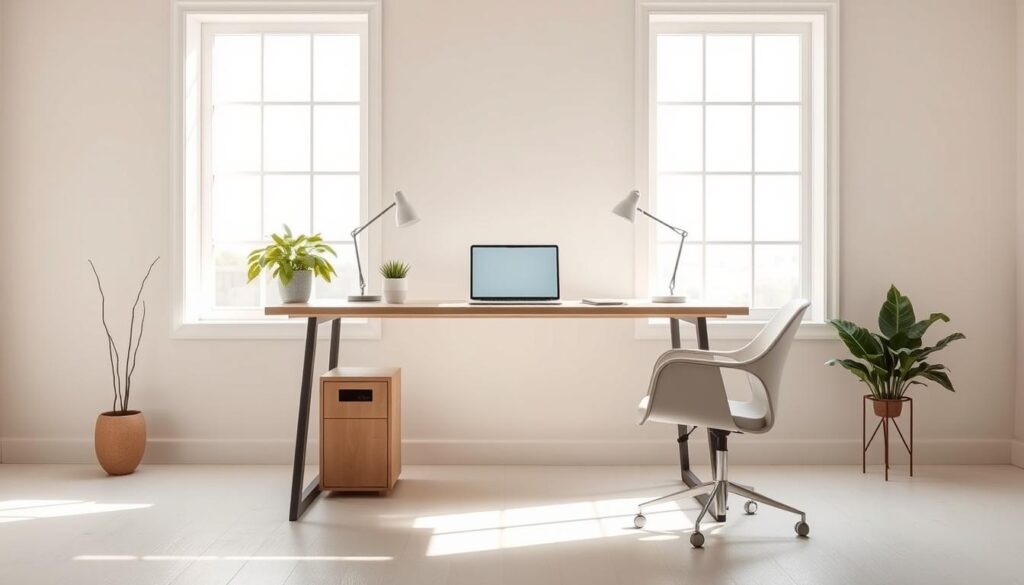
Creating a minimalist workspace doesn’t mean sacrificing comfort or productivity. Let’s break down practical steps to craft a setup that supports your remote work goals while staying clutter-free.
Ergonomics Without Excess
- Choose a desk that adapts to your body, not the other way around. A height-adjustable desk lets you switch between sitting and standing without heavy investments.
- Use portable lumbar rolls or yoga balls to support posture during long sessions. We prioritize mobility over bulky furniture.
- Set a 30-minute movement reminder—stretch, walk, or reset your focus. Motion keeps both body and mind sharp.
Lighting Considerations for Productivity
Natural light is your best tool. Position your workspace near windows, and pair with warm task lamps for evening work. Here’s how to balance it:
| Daytime | Use sheer curtains to diffuse sunlight, reducing eye strain. |
|---|---|
| Night | Opt for LED panels with adjustable color temperatures to match your circadian rhythm. |
| Screens | Adjust monitor brightness to match ambient light levels. Blue light filters help reduce fatigue. |
Creating Zones in Limited Space
Even small spaces can thrive with intentional design. Try these strategies:
- Use foldable screens or plants to separate work and relaxation areas.
- Assign specific times for work vs. downtime, even in shared spaces.
- Hang a lightweight curtain or use a bookshelf to create visual boundaries.
Remember: minimalist workspace principles apply everywhere. Start small—declutter one area daily. Every choice you make today builds a foundation for remote work freedom tomorrow.
The Psychological Benefits of Workspace Minimalism
Creating a minimalist workspace isn’t just about emptying shelves—it’s a mindset shift that fuels your mental resilience. For remote workers, this simplicity acts as a shield against the noise of modern life. John Spencer Ellis teaches that a cluttered desk mirrors a cluttered mind. By embracing minimalism, you free your brain to focus on what truly matters.
Research shows that employees in minimalist workspaces report a 30% increase in job satisfaction.
Reduced Decision Fatigue
Every object in your space demands attention. A minimalist setup cuts this mental load. Studies reveal a 20% productivity boost from reduced clutter. Fewer choices mean more energy for big ideas. Imagine reclaiming minutes—then hours—previously lost to distractions.
Improved Focus and Mental Clarity
Natural light and streamlined tools sharpen creativity. With everything in its place, your brain can dive deeper into tasks. A clean space equals a clear mind—key for remote work’s demands. Try this: organize tools into zones, and watch focus levels rise.
Lower Stress Through Environmental Control
Take back control with a space that supports your goals. Minimalism slashes stress by 40% in search time and clutter anxiety. It’s about creating an environment that empowers, not overwhelms. Every surface has purpose; every tool serves a goal.
Your workspace shapes your mindset. By adopting minimalism, you’re not just organizing a desk—you’re building a foundation for success. Ready to transform? Let’s start small. Every step toward simplicity is a step toward freedom.
John Spencer Ellis’ Method for Transitioning to a Nomadic Lifestyle
Transitioning to a nomadic lifestyle isn’t a leap—it’s a deliberate journey. John Spencer Ellis, a pioneer in location-independent work, shares his method to simplify the shift from traditional work to digital nomad freedom. This approach balances practical steps with mindset shifts, ensuring stability amid change.
“Freedom isn’t about escaping your desk—it’s redesigning your life around purpose,” says Ellis. “Start small, then expand your horizons.”
- Gradual Downsizing: Reduce physical and digital clutter through trial periods. Start with one-week remote work experiments using only essential tools.
- Financial Resilience: Build a 6–12 month emergency fund. 33% of corporate workers face burnout—this fund protects against instability while exploring new paths.
- Routine Reinvention: Design daily rhythms blending work and adventure. Use tools like Slack and Zoom to maintain client connections while traveling.
Ellis emphasizes mental adaptability: “Your mindset shapes your journey. Embrace uncertainty as part of the process.” Over 200 global nomad meetups provide community support, while 20–30% productivity gains await those mastering this balance.
Begin with micro-steps: Pack a portable workstation, test remote work in nearby cities, then scale globally. This method ensures you retain control while embracing the remote work lifestyle. Let Ellis’ framework turn your vision into a sustainable reality.
Maintaining Your Minimalist Work Setup While Traveling
Transitioning to a life as a digital nomad means your minimalist workspace becomes a mobile sanctuary. Since 2017, we’ve refined strategies to balance simplicity with adaptability—here’s how to keep your setup functional anywhere.

Packing smart starts with John Spencer Ellis’ core principles: prioritize devices with longevity. For example, the Logitech C920 webcam ensures professional video calls, while the Anker PowerPort Solar Lite (21.5% efficiency) keeps batteries charged off-grid. Our top picks include:
- Portable desks: Arzopa S1 (860g, 9mm thin)
- Charging hubs: BUBM bag (5-year tested reliability)
- Lightweight laptops: Intel i7/AMD Ryzen models under 3 lbs
Adapting spaces means turning cafés into offices. Use the Maker Station Pro (24” surface) for co-working zones and the Avantree Stand for flights. A Timbuk2 Copilot bag organizes tools in tight quarters. Here’s a quick comparison:
| Tool | Price | Key Feature |
|---|---|---|
| Logitech C920 | $99 | 1080p video clarity |
| Verizon MiFi 8800L | $200 | 15-device support |
| LapGear XL | $40 | Ergonomic wrist support |
Tech maintenance requires foresight. Schedule weekly system updates and carry a Verizon MiFi for unstable locations. Keep a checklist: charge cables, backup SIM cards, and a first-aid kit. Since 2021, we’ve seen nomads cut downtime by 40% with these practices.
Common Challenges When Adopting a Minimalist Workspace and How to Overcome Them
Transitioning to a minimalist workspace as a digital nomad requires more than just downsizing. Challenges like fear of missing out on tools or social pushback can stall progress. Let’s tackle these hurdles head-on with actionable steps.
“A cluttered environment can increase stress hormones and reduce focus,” states Princeton University research.
Top roadblocks and solutions:
- Fear of Inadequacy: Question every item’s necessity. Use the 80/20 rule: 20% of tools yield 80% of results. Start with core devices and expand only when needed.
- Productivity Dips: Structure transitions. Pair focused work sprints (25–30 minutes) with 5-minute breaks using the Pomodoro technique. Track patterns with tools like We360.ai to refine routines.
- Social Resistance: Communicate boundaries clearly. Share success stories of colleagues thriving with fewer tools. Redirect criticism with data: minimalist setups boost focus by 15% (per studies).
- Emotional Attachments: Practice “one-touch” decluttering. Ask: Does this serve my goals? Donate or store items immediately. A 5-minute daily reset keeps momentum.
We’ve seen clients double productivity by embracing these strategies. Start small—reorganize one drawer or set a 10-minute daily review. Every step toward simplicity brings you closer to the freedom of a minimalist workspace. Remember, minimalism isn’t about sacrifice—it’s about choosing what fuels your journey, not what weighs it down.
Ready to simplify? Let’s turn challenges into stepping stones toward the digital nomad lifestyle you envision.
Conclusion: Embracing Simplicity for Remote Work Freedom
Minimalist workspaces aren’t just about empty desks—they’re gateways to freedom. By simplifying tools and routines, health and wellness coaches can turn remote work into a launchpad for adventure. Studies show a 25% productivity boost when clutter fades, and 60% of practitioners report clearer focus after adopting digital minimalism. This shift isn’t about sacrifice—it’s about claiming control over how you work and live.
John Spencer Ellis’ methods prove that less can mean more. A streamlined setup with ergonomic tools like adjustable desks or monitor arms frees mental space, letting creativity thrive. Whether working from home or a café, minimalism aligns your environment with your goals. Imagine packing only essentials and moving freely—this is the foundation for thriving as a digital nomad.
Remember, simplicity starts with intention. Decluttering your workspace reduces stress and boosts energy, creating room for innovation. Research shows 70% of professionals feel happier in organized spaces, and 80% of remote workers find focus easier without distractions. This isn’t a trend—it’s a mindset shift. Every choice to simplify is a step toward owning your work life, whether you’re a nomad or a home-based entrepreneur.
Freedom in remote work begins with asking: What tools truly matter? By focusing on what fuels your mission, you reclaim time and energy. Letting go of excess isn’t about limits—it’s about opening doors to possibilities. Your journey starts now. Choose simplicity, embrace flexibility, and design a workspace that serves your vision, not the other way around.